
We’re now only a couple of weeks away from the April 1 implementation of the Goods and Services Tax (GST) in Malaysia. Much has been said, rumoured and conjectured since the new tax regime was announced in Budget 2014, particularly with regards to the car industry and the all-important, hotly-debated question: Will car prices go up or down with GST?
Since the 6% GST will supersede the existing 10% sales tax imposed on new vehicles, it’s easy to assume that car prices will drop by 4%. Simple enough equation, but as we’ve found out, that will not be case.
“Generally, I would expect a slight drop for new cars between 1-3%,” said Royal Malaysian Customs Department GST director Datuk Subromaniam Tholasy. Malaysian Automotive Association (MAA) president Datuk Aishah Ahmad, however, isn’t quite so optimistic. “I do know some brands, prices will go up. Not everybody comes down,” she told paultan.org.
Apart from car prices, we also discussed the impact GST will have on other corners of the industry, including used vehicles, pre-registered cars, company-registered cars, servicing and parts. What will, and what won’t change? Clearly, the answers aren’t as straightforward as we may think…
GST replaces sales tax: the mechanism
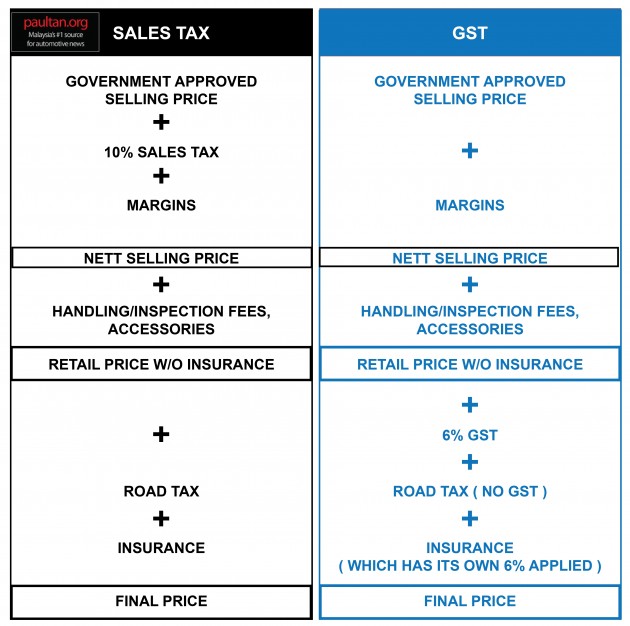
Come April 1, this sales tax regime will be abolished, and a GST of 6% will take its place. In its simplest form, GST is a value-added tax, that is, a tax paid on the value added to a product or service. It is applied at each stage of the business transaction, through distribution, retail and finally to the consumer.
It is important to note that it won’t be a 6% GST added on top of each and every business transaction, thereby increasing the price of the car at an exponential rate. GST is indeed imposed on the selling price, margins included, each time the car changes hands down the supply chain, but at each stage except for the final consumer, input tax can be claimed. In the end, it is the consumer who pays the full GST rate.
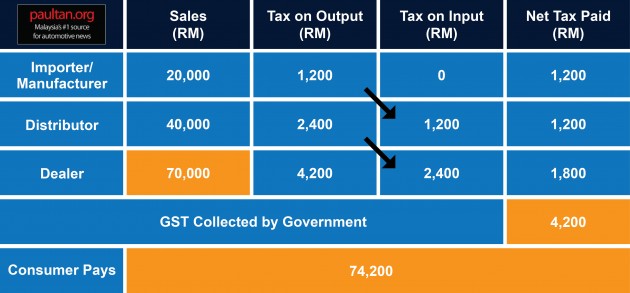
In filing his tax returns, the distributor will declare his output tax (6% paid by the dealer, bigger amount) and input tax (6% he paid previously, smaller amount). He then pays the difference between the two to the government.
The dealer repeats the process in selling the car to the consumer. The consumer cannot claim any input tax, so he bears the full GST burden, as stated earlier: 6% of the final purchase price. Essentially, each part of the net tax paid in the chain should add up to the 6% paid by the consumer.
How will new car prices be affected?
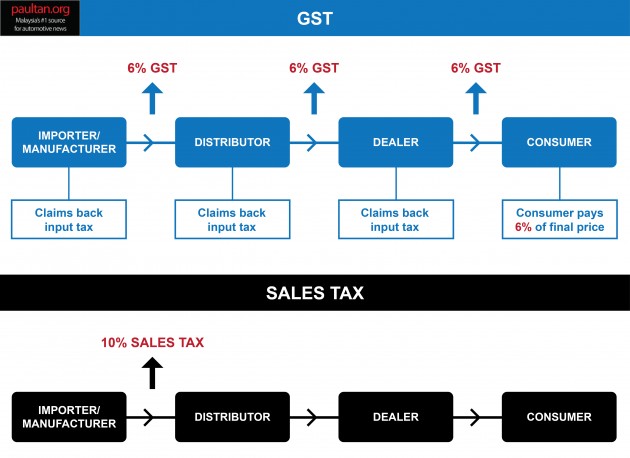
“There is a possibility that for some models there may not be any reduction or we could even see a slight increase in prices, especially for imported cars. Because it depends on the distribution margin, which is currently (under the sales tax regime) not taxed.”
The premise behind all this is such – GST is a value-added tax, which means it is a tax on distribution margins. The higher the distribution margins, the more in GST needs to be paid and ultimately, the more expensive the car becomes for the consumer.